PMCS Oneself
(Personal Maintenance Checks and Services)
Every week, equipment inspections are conducted to ensure tools and systems are fully operational. These inspections—done before, during, and after use—follow a detailed, step-by-step process. When issues such as missing parts, damage, or unusual sounds are identified, they are documented and addressed immediately. This proactive approach ensures safety, reliability, and readiness.
Now, think of yourself as that system. Success doesn’t just depend on external tools—it depends on you being fully ready as well. That’s why I encourage you to apply the same concept of PMCS—Personal Maintenance Checks and Services—to yourself mentally, spiritually, and physically.
Mental & Spiritual PMCS
Just as equipment is routinely inspected, we should regularly check in on our own emotional and psychological well-being. Begin with a self-assessment to evaluate your current mindset and behavior. Take time to reflect on what you discover. If something feels off—if you’re struggling mentally, emotionally, or spiritually—acknowledge it. Talk about it, write it down, and seek support. This could mean reaching out to a counselor, spiritual advisor, or a trusted person in your life. Early awareness leads to early resolution.
In addition, I encourage the practice of mindfulness—a simple yet powerful tool for managing stress, anxiety, and depression. Mindfulness is not tied to any religion and is accessible to everyone. It involves turning inward: closing your eyes, calming your mind, and honestly examining your thoughts, emotions, and current challenges. This self-reflection helps you better understand who you are and what you need.
One reflection exercise focuses on personal values and character traits such as Strength, Responsibility, Love, Duty, Integrity, Excellence, and Resilience. By reflecting on each of these qualities, ask yourself: Am I truly living in alignment with my values? This process often reveals the root of inner struggles—whether frustration, sadness, or feeling lost. Through deeper self-awareness, we gain clarity and can take meaningful steps toward improving our overall well-being and readiness for life’s challenges.
After completing your self–PMCS, take a moment to review the readiness chart and assess where you currently stand. If you’re in the green zone, you’re in a good place—mentally and spiritually balanced. Maintain that stability through consistent habits, reflection, and self-awareness. Be mindful, though, that neglecting this upkeep over time can cause your readiness to shift into yellow, orange, or even red.
If you find yourself in the yellow zone, treat it as an early warning. Something needs attention, and ignoring it may lead to further strain. This is a good time to pause and reach out for support—whether that’s a counselor, healthcare provider, wellness professional, spiritual advisor, or a trusted person in your life—to help restore balance and direction.
If you’re in the orange zone, understand this is a serious signal, not a permanent state. You can rebuild. Use this moment as an opportunity to reflect, heal, and grow. Begin with self-forgiveness and extend that same grace to others. Focus on forming meaningful connections, staying open to change, and accepting the support available to you.
For those in the red zone, know that this is not a failure—it’s a turning point. You may be facing significant challenges, but help is available and recovery is possible. This is a time to reset and rebuild. Start by showing compassion to yourself and practicing honest communication. Healing begins through connection, understanding, and a willingness to seek and accept help.
Everyone has the capacity to recover, grow, and maintain holistic health and well-being—not only for personal balance, but also for the strength and resilience of the people and communities around them.
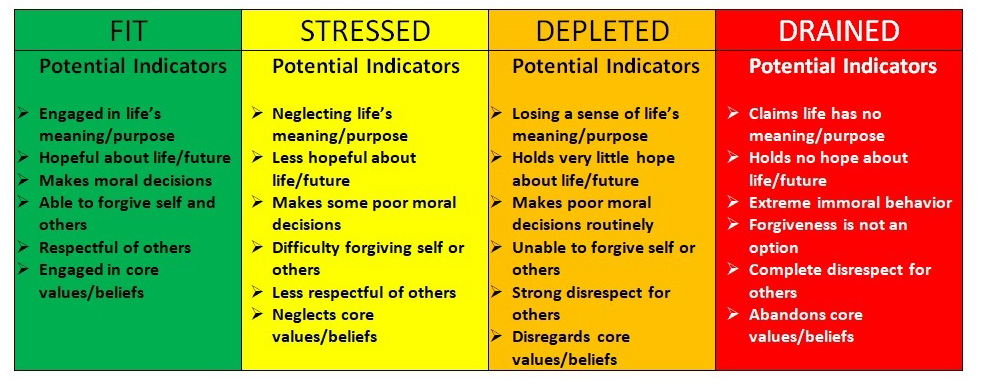
No matter where you fall on the chart, remember this: readiness is not a fixed state—it’s a journey. Remember, everyone is capable of achieving and sustaining holistic health and fitness. Through reflection, connection, and consistent effort, anyone can regain balance and maintain holistic health—for themselves, their unit, and the entire community.
Physical PMCS
Daily physical training keeps us strong and mission-capable. Whether you prefer running, swimming, ruck marching, or lifting weights, the key is consistency. Find the exercises that suit your body and goals. Just like equipment needs recovery time and inspections, so does your body. Stay alert to signs like soreness, tightness, or swelling—because you know your body best.
One method I personally use for physical PMCS is yoga stretching. Think of it like testing a vehicle’s ability to turn, reverse, and accelerate. Yoga helps me evaluate how well my joints and muscles are functioning. If I notice restricted movement or discomfort, I start with stretching for recovery and, if needed, seek professional care. It helps me stay mobile, prevent injury, and keep my body running smoothly.
PMCS isn’t just for vehicles—it’s for the operator/driver, too. Take care of yourself, because you are essential to the life journey along the way.
PMCS your body by Yoga Stretching